
According to a report in The Bakersfield Californian, a dentist died while performing a routine teeth cleaning.
“A dentist in Arvin died last week while performing a routine teeth cleaning, the California Department of Industrial Relations’ Division of Occupational Safety and Health reported Wednesday,” the outlet wrote.
The report said the Kern County coroner’s office confirmed the death to be cardiac arrest.
“A dentist in California died last week while performing a routine teeth cleaning, as reported by the California Department of Industrial Relations Division of Occupational Safety and Health.
According to the Kern County coroner's office, the cause of death was confirmed to be… pic.twitter.com/mLgLMfj3ow
— Chief Nerd (@TheChiefNerd) December 29, 2023
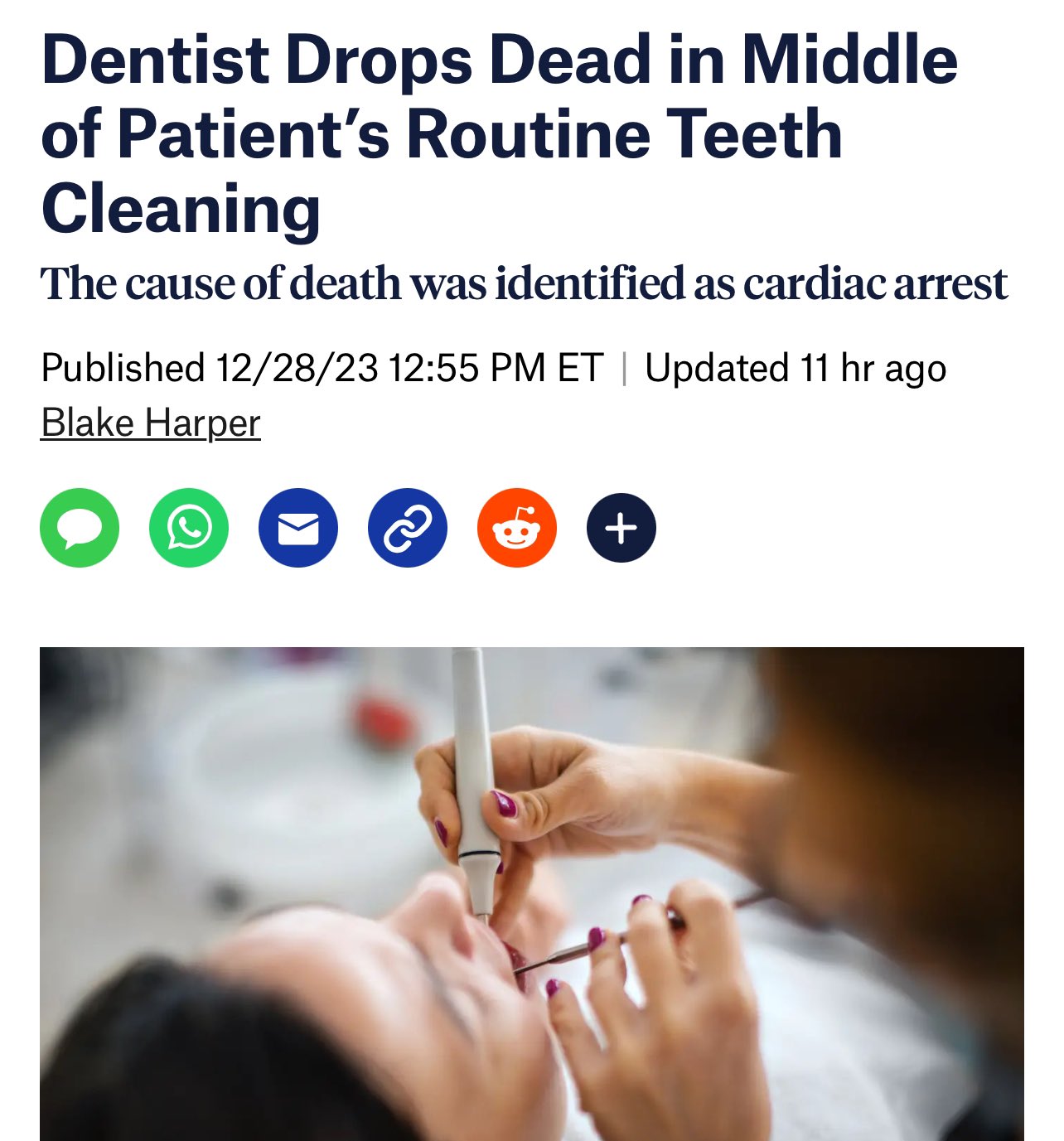
Dentist Drops Dead in Middle of Patient’s Routine Teeth Cleaning
The cause of death was identified as cardiac arrest https://t.co/AuIeQDYkOK
— “Sudden And Unexpected” (@toobaffled) December 29, 2023
The Bakersfield Californian reports:
The death was reported to state authorities on Dec. 21, the same day the incident occurred. The Kern County coroner’s office confirmed the cause of death was cardiac arrest.
The incident occurred at the office of Dr. Sandra J. Gong, which is closed for the holidays and could not be reached for comment Wednesday.
ADVERTISEMENTThe DIR also could not be reached for comment.
Although it won’t be reported, many people will speculate if the deceased dentist took the experimental COVID-19 shot.
Additional studies continue revealing the cardiac risks related to the shot.
Researchers found that the COVID-19 shot may trigger Takotsubo cardiomyopathy.
“The researchers conducted a literature search and included 15 case reports involving a total of 16 patients. Among them, 14 individuals received mRNA vaccines (Pfizer, Moderna), while two received viral vector vaccines (AstraZeneca). Seven patients developed Takotsubo… pic.twitter.com/DJYgLFs2x9
— Chief Nerd (@TheChiefNerd) December 29, 2023
Chief Nerd writes:
“The researchers conducted a literature search and included 15 case reports involving a total of 16 patients. Among them, 14 individuals received mRNA vaccines (Pfizer, Moderna), while two received viral vector vaccines (AstraZeneca). Seven patients developed Takotsubo cardiomyopathy after the first dose and seven after the second dose.
All patients exhibited elevated cardiac troponin levels, abnormal electrocardiogram findings, and reduced left ventricular ejection fraction on echocardiograms. The most predominant symptom among patients was chest pain, followed by dyspnea and nausea. Eventually, 14 patients recovered and were discharged, while two of the patients died.
The paper’s authors urge clinicians to consider the possibility of Takotsubo cardiomyopathy, especially among recipients of mRNA vaccines when presented with patients experiencing chest pain or dyspnea symptoms after vaccination.”
From The Epoch Times:
In August, a case report was published in the journal Cureus detailing the experience of a 59-year-old woman who developed Takotsubo cardiomyopathy after receiving a booster dose of the COVID-19 vaccine. The patient experienced persistent dyspnea for six hours, prompting her visit to the emergency department. According to the patient’s account, she had been experiencing intermittent chest pain for the past two days, described as a stabbing sensation that progressively intensified with each episode but did not radiate to other areas. Exertion worsened the pain, and there was no relief method. The patient had received the Moderna vaccine booster dose three days prior.
The patient did not have a fever and remained conscious, with a blood oxygen saturation of 89 percent and blood pressure at 150/90 mmHg. Crackling and rattling sounds known as crepitations were detected in her lungs. A COVID-19 polymerase chain reaction test yielded a negative result. The emergency electrocardiogram showed ST-segment elevation, a chest X-ray revealed pulmonary edema and an ultrasound indicated reduced left ventricular systolic function, with an estimated ejection fraction of 30 percent. Additionally, there was moderate hypokinesia (abnormally diminished motor activity) in the apex and anterior wall of the heart.
ADVERTISEMENTThe patient continued to experience tachycardia and blood pressure fluctuations, leading to hemodynamic instability due to fluid overload and ultimately resulting in cardiac shock. The medical team administered intravenous injections of norepinephrine and dobutamine for treatment. As no other etiologies were identified, she was diagnosed with Takotsubo cardiomyopathy.
The patient showed improvement and was discharged on the sixth day but continued to experience persistent tachycardia, requiring treatment with metoprolol, a medication for the treatment of high blood pressure.


